

Repeated unwanted contact, surveillance or intimidation can be frightening, even when the person calls it love. You do not owe someone a relationship, a meeting or an explanation because they send gifts or say they miss you. Stalking concerns deserve attention without waiting for a physical assault.
If you are in immediate danger, contact your local emergency services if you can do so safely. If someone may monitor your device or accounts, consider seeking help from a device they cannot access.
On this page
Recognize the pattern
Look at what is happening across incidents and how it affects your freedom and safety. An isolated unknown call does not establish stalking. Repeated unwanted calls, following, monitoring accounts or appearing where you are can form a concerning pattern.
Unexpected appearances near home, work or school matter in context, especially alongside other unwanted contact. You do not have to approach the person or investigate why they are there.
Someone may also seek information through friends, shared accounts or online posts. Knowing your location does not prove intuition or a special connection.
Unwanted gifts do not create a debt. Having accepted a gift or replied previously does not make you responsible for what someone does next.
Threats, property damage and threats against people or animals you care about are serious concerns. Share them with an appropriate support service rather than trying to manage the person alone.
Impersonation, publishing private information or encouraging others to contact you can be part of the same pattern. The National Domestic Violence Hotline’s stalking guidance describes both physical and online tactics.
Put immediate safety first
You can seek support when something feels unsafe even if you are uncertain what to call it. A useful first sentence is: “Someone keeps contacting or following me, and I am worried about what happens next.”
You do not have to confront them, meet for closure or prove your case to them. There is no single response that guarantees the behavior will stop. Decisions about contact need to fit your circumstances, including shared children, housing or work.
If safe, tell a trusted person what help you want. For example: “Please do not share my location or pass along messages. If I use our agreed check-in phrase, call me and follow the plan we discussed.” Choose someone who will respect your decisions.
Keep records when it is safe
A record can help you explain a pattern without having to remember everything at once. SPARC provides incident logs and victim handbooks. Useful details can include the date, location, what happened, witnesses and any report number.
Keep relevant messages and original files where the person cannot access them, if possible. Avoid putting yourself at risk to obtain evidence. The Safety Net Project’s documentation guidance explains that some apps notify others about screenshots and that reporting content may remove it. A safer documentation method may be needed.
Plan technology changes carefully
Blocking someone, changing passwords, removing a tracker or resetting a phone can affect both safety and evidence. Before making changes, consider how the person might react and whether you need help preserving information.
The Safety Net Project’s technology safety plan recommends considering a safer device and planning around possible escalation. A reset is not a complete safety plan; accounts, shared services and other devices may still provide access.
Find support for your situation
A stalking or domestic-abuse advocate can help you think through daily routines, safe ways to communicate and local services. In the United States, the National Domestic Violence Hotline is available at 800-799-7233. Outside the US, look for a local victim-support service.
Legal definitions, reporting processes and protective orders vary by location. A local advocate or qualified legal service can explain options; no report or order guarantees protection. You can ask what information a service keeps and who may see it before sharing details.
It is possible to miss someone while still needing distance from them. For that emotional side, read about letting go of a relationship. For controlling behavior, explore boundaries and support without needing to diagnose a partner.
When unwanted contact moves across places
If someone repeatedly appears near work and sends messages after you have asked for no contact, consider a safe way to reach local victim support. Tell them where the contact is happening and whether the person may access your devices or accounts.
The advocate can help you consider ordinary routines, contact at work and how to document what happened if safe. In immediate danger, contact local emergency services if you can reach them safely.
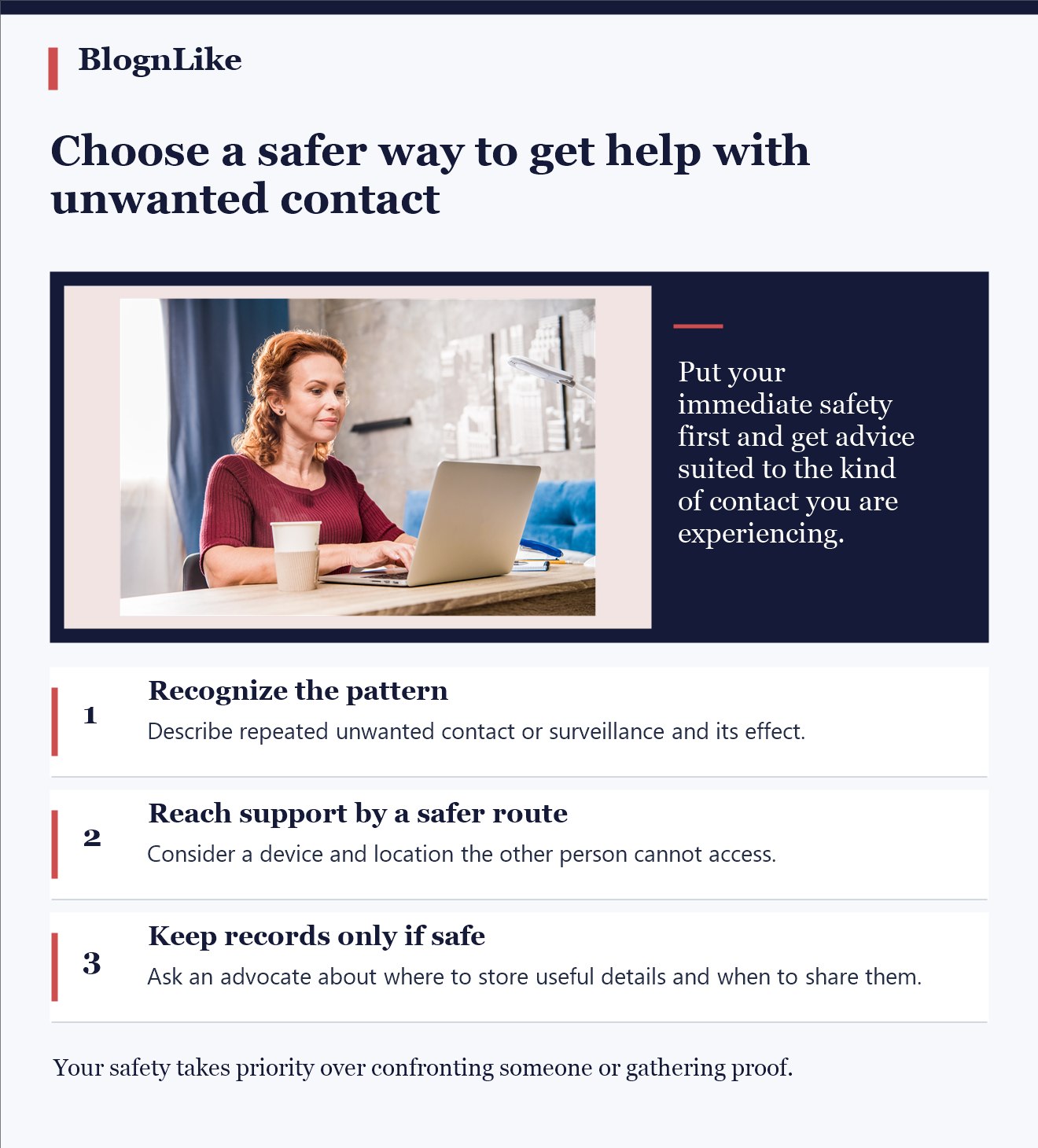
Read the infographic in text
Choose a safer way to get help with unwanted contact
Put your immediate safety first and get advice suited to the kind of contact you are experiencing.
- Recognize the pattern Describe repeated unwanted contact or surveillance and its effect.
- Reach support by a safer route Consider a device and location the other person cannot access.
- Keep records only if safe Ask an advocate about where to store useful details and when to share them.
Your safety takes priority over confronting someone or gathering proof.
Frequently asked questions
1. Do I need to know whether the behaviour fits a legal definition?
No. You can seek support for a pattern of unwanted contact or monitoring before you understand how local law applies.
2. What should I do if I think the other person can access my phone?
Consider reaching support from a safer device or location. Get advice before changing settings in a way that could alert them.
3. Do I have to collect evidence before I can ask for help?
You can ask for help whenever you need it. Keep records only when it is safe, and get advice about how and where to store them.
4. Who can help with unwanted contact at work?
A victim advocate can help you consider workplace options. If appropriate, a trusted manager, security contact or designated support person can discuss local procedures with you.
5. What should I do if I am in immediate danger?
Contact local emergency services if you can do so safely. A safe location or trusted person may also help you reach appropriate local support.