

If you want to explore opening your chakras, begin with a gentle question: what would you like to make room for in your life? You might be looking for steadiness, clearer communication, creativity or connection. A short reflective practice can give those wishes a place to go without requiring a dramatic experience.
Chakras are part of spiritual traditions. The guide below uses a seven-chakra framework as a set of themes for reflection, with one practical choice for each. You can explore one theme, change the suggested activity or leave it for another day.
Keep spiritual practice and health questions distinct
In a chakra framework, energy centres offer a way of thinking about spiritual life and experience. They are not a medical map of your organs. Pain, tiredness, low mood or a change in sexual desire does not establish that a chakra is blocked, and a feeling of warmth or tingling does not prove one has opened.
If you are concerned about a symptom, seek appropriate health care rather than waiting for a spiritual practice to resolve it. The National Center for Complementary and Integrative Health’s meditation guidance also advises against using meditation to replace or postpone conventional care. You can value spiritual reflection while getting help with a concrete concern.

Before you begin, choose a gentle approach
Use a comfortable seat and let your breathing stay natural. Your eyes can remain open. There is no need to hold your breath, force a posture or work through discomfort. Start with one of the themes below and consider its question; you do not have to work through all seven in order.
If inward attention feels upsetting, pause and look around the room, or choose an ordinary activity instead. Meditation does not feel helpful to everyone. A practice should leave room for your choice to stop, and you do not need to interpret discomfort as spiritual progress.
Root chakra, Muladhara: stability and support
Use the root theme to consider what supports you in daily life. Stability can involve routines, reliable information, practical resources and people you can contact. You do not need to feel completely secure before taking a small step toward something more manageable.
What does feeling grounded mean to you?
Ask what “grounded” would look like today. Perhaps you would know the plan for the evening, have a task written down or have someone to ask for help. Be specific about your circumstances. Worry about housing, work or relationships deserves practical attention, rather than a judgment that your energy is wrong.
Try one practical anchor
Notice the support of your chair or the floor beneath your feet, if that feels comfortable. Then choose a practical anchor: put an appointment in your calendar, prepare something you need for tomorrow or contact a trusted person. You can finish after that one action; there is no sensation you must produce.
Sacral chakra, Svadhisthana: preference and creativity
For this theme, explore what you enjoy and what you would like more room to try. Creativity can be small and ordinary: arranging a meal, choosing music or making something with your hands. Your preferences do not have to match anyone else’s idea of a spiritual lifestyle.
Make room for preference and pleasure
Ask, “What sounds appealing, and what am I agreeing to out of habit?” You can change your mind about an activity or decide you do not want it. Sexual desire is not a measure of spiritual success, and no interpretation of this chakra should pressure you into sexual activity or unwanted touch.
Choose an activity without a performance goal
Pick something you can enjoy without needing to become good at it. Sketch a familiar object, listen to a song or try a new arrangement of things you already own. If nothing appeals today, rest or choose another theme. The point is to make room for a preference, rather than force enjoyment.
Solar plexus chakra, Manipura: choice and confidence
Use this theme to think about decisions you can make and limits you can name. Confidence need not mean certainty, dominance or constant productivity. It can mean giving yourself time to consider an offer and answering honestly about what you can do.
Notice where you have a choice
Separate what is yours to decide from what belongs to someone else. You can express interest, ask a question or decline a plan. You cannot decide another person’s feelings or make them commit. Identifying that distinction can help you choose an action without taking responsibility for an outcome you do not control.
Practise one small boundary
Choose a sentence that fits an everyday situation: “I need to check my schedule,” “I would prefer another time,” or “I am not comfortable with that.” A boundary does not need an elaborate justification. In a relationship, look for whether both people can express a limit and have it taken seriously.
Heart chakra, Anahata: care and connection
Let the heart theme open a question about the care you offer and the care you receive. Connection can include a partner, friends, family, community or a pet. It does not require a romantic relationship, constant affection or unlimited access to you.
Let care include yourself
Consider one way to be considerate without overextending yourself. You might offer a specific kind of help, ask someone what support would be useful or acknowledge that you need a break. For more on balancing affection and choice, read Affection in Relationships: Care, Comfort and Consent.
Keep forgiveness a choice
You do not have to forgive, reconcile or remain available to someone in order to be spiritually open. If a relationship has hurt you, consider what contact, distance or support you want now. Kindness can coexist with firm limits. Another person’s wish to reconnect does not settle what is right for you.
Throat chakra, Vishuddha: communication
Use this theme to consider what you want to express and how you want to listen. Clear communication can be quiet, written, spoken or supported by another person. It does not require a forceful voice, and saying less can be a valid choice.
Clarify what you want to say
Write one sentence about the situation and one about your request. For example: “When plans change without a message, I do not know what to arrange. Can we let each other know?” Keep the request specific enough that the other person can understand it and respond.
Choose a workable way to communicate
Pick a time and format you can use freely. If a discussion becomes threatening or you fear retaliation, prioritise support and safety over practising a difficult conversation. In an ordinary disagreement, you can ask for a pause and agree when to return. You are allowed to need time to find your words.
Third-eye chakra, Ajna: reflection and intuition
This theme can invite you to notice impressions, assumptions and unanswered questions. You can respect an intuitive feeling without treating it as proof. Curiosity gives you room to consider another explanation and ask what information would help you decide.
Separate an impression from evidence
Try three short notes: “What I noticed,” “What I think it means,” and “What I do not yet know.” A delayed reply, for instance, is an observation; deciding that someone has lost interest is an interpretation. Their explanation and their broader pattern of behaviour may give you more to work with.
Make space for uncertainty
You can leave a question open rather than seeking repeated signs or readings. Choose one proportionate next step, such as asking directly, checking a practical detail or allowing more time. If you want another spiritual perspective, the existing guide to reflecting on your higher self explores a related theme.
Crown chakra, Sahasrara: meaning and connection
Use the crown theme to ask what gives your life meaning. That may include faith, learning, relationships, service, nature or everyday commitments. You do not need an extraordinary experience or a sense of connection to everything for your answer to matter.
Reflect on a value you want to practise
Choose a value and give it an ordinary expression. If you value generosity, what can you offer without exhausting yourself? If you value learning, what would you like to understand better? A value can guide a small decision today without becoming a test of how spiritually developed you are.
Keep everyday support in view
A sense of meaning can sit alongside routines, friendships and practical help. You can enjoy prayer, quiet reflection or time outdoors and still need company or professional support. Spiritual connection does not require withdrawing from the people and resources that help you navigate daily life.
Keep colours, crystals and rituals optional
If a colour, a familiar object or a short phrase helps you focus, you can include it. You can also practise without buying anything. These are optional reminders of an intention, rather than proof that a chakra has opened or that a health condition has changed.
Choose a simple setup that feels comfortable and leave out anything that creates pressure. You do not need a perfect room, a prescribed outfit or someone else’s approval to take a reflective moment.
Finish with one practice and one practical next step
Choose the theme that speaks to you today, consider its question and decide whether there is an action worth taking. Afterwards, ask whether the practice felt useful or whether you would prefer another approach. You do not need to grade the session or search for evidence of an energy shift.
If your reflection concerns a relationship, the weekly check-in guide offers concrete questions about care, workload and support. A useful next step may be a conversation, a boundary or a small plan you can actually carry out.
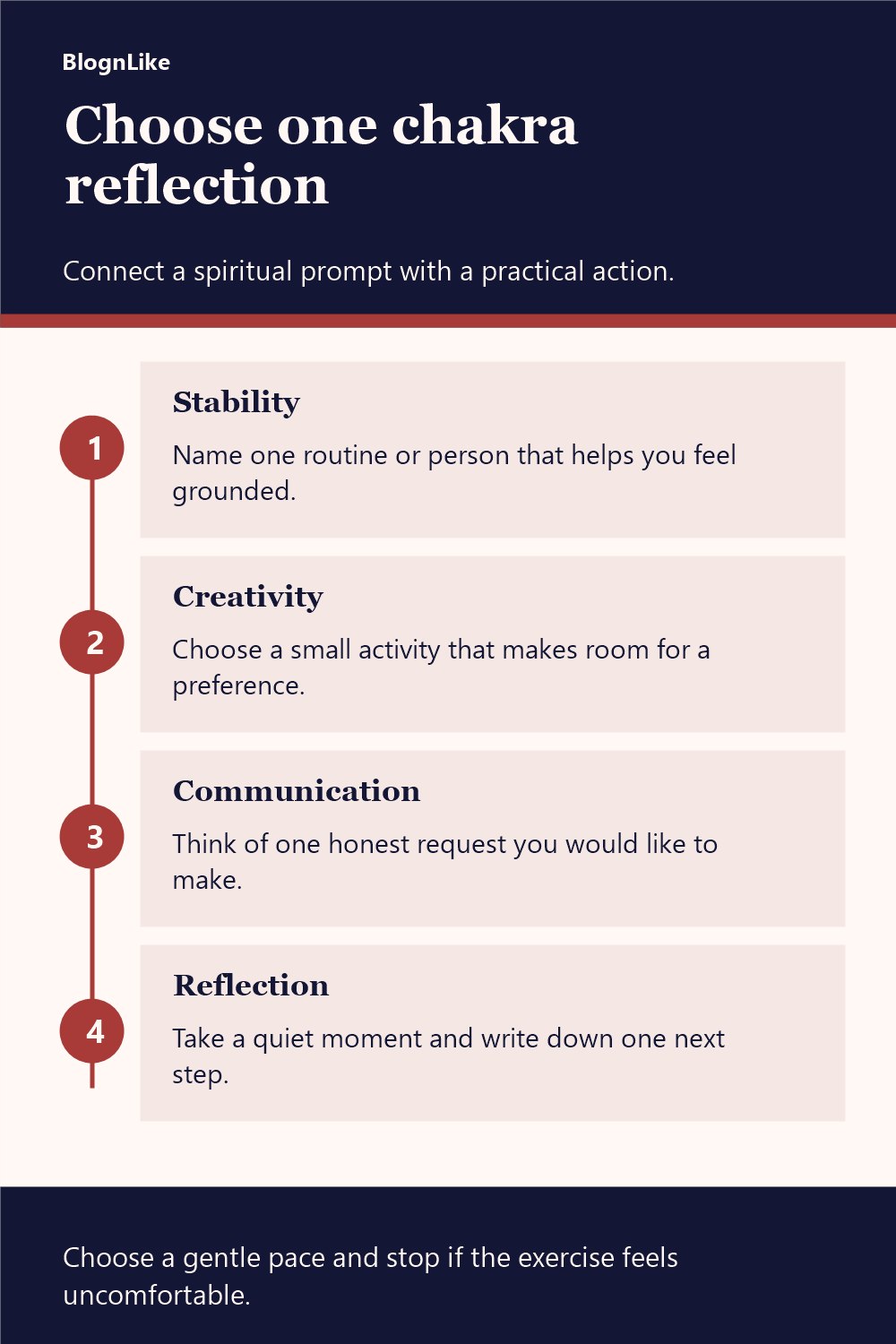
Read the infographic in text
Choose one chakra reflection Connect a spiritual prompt with a practical action.
- Stability Name one routine or person that helps you feel grounded.
- Creativity Choose a small activity that makes room for a preference.
- Communication Think of one honest request you would like to make.
- Reflection Take a quiet moment and write down one next step.
Choose a gentle pace and stop if the exercise feels uncomfortable.