

If you are depressed and questioning your relationship, you may be unsure how much of what you feel relates to your symptoms, your partner’s behaviour or a mismatch that was already there. You do not have to answer every part of that question at once.
Depression does not remove your right to make choices about a relationship. It also does not require your partner to become your only source of care. Start with safety, appropriate support and the specific concerns that are making you consider a breakup.
On this page
Consider care and relationship concerns separately
The National Institute of Mental Health explains depression treatment as an individual plan that may include psychotherapy, medication or both. Discuss symptoms and options with a qualified healthcare professional rather than assuming that time, exercise or a loving partner will be sufficient treatment.
Alongside that care, your relationship may have issues that deserve their own attention. Feeling dismissed, wanting a different kind of commitment or disagreeing about the future is not automatically a symptom to be ignored. Likewise, feeling less interested in activities or closeness does not on its own establish that you no longer love your partner.
You can bring both questions to an appointment: “I am struggling with my mood, and I am also uncertain about my relationship. I would like help thinking clearly about each.”

Notice what has changed
If it is manageable, make a short note of what concerns you and when it began. Separate your partner’s actions, your own experience and any agreement you would like to discuss.
- Were these concerns present before the current period of low mood?
- Do you feel heard when you raise a specific issue?
- Are there moments when the relationship feels caring or workable, and what is different about them?
- Is there a practical change you want to request?
- Are you afraid of how your partner will react if you disagree or leave?
These questions are prompts for reflection, not a test that tells you to stay or go. You can stop writing if it becomes another source of pressure and talk with someone instead.
Ask for practical support
You might want company at an appointment, help with a meal or a quieter way to spend time together. Ask clearly and allow your partner to explain what they can manage: “Could you come with me on Tuesday?” or “I would like to talk, but I only have energy for a short conversation.”
A partner can care and still have limits. Try to build support beyond the relationship, which may include a clinician, trusted friend, family member or appropriate service. Treatment decisions remain something to discuss with your healthcare professional.
You can decide how and when to share personal health information. If you are worried it will be used to shame, threaten or control you, seek individual support before disclosing more.
Make room for a considered decision
If the situation is safe and you want time, you can pause a major decision while you seek care and gather perspective. Choose what that pause means: a particular conversation, an appointment or a date to revisit an unresolved agreement. It does not have to mean waiting indefinitely for perfect certainty.
You may decide to continue, change an arrangement or end the relationship. You do not need to prove that depression caused every difficulty, and you do not owe a commitment to stay because your partner has supported you. Consider the practical support you would need for either choice.
If you choose to break up, think about housing, belongings, shared responsibilities and the support available afterwards. You can keep the explanation focused on your decision without promising that either person will quickly feel better.
Put safety and urgent help first
If there are threats, coercion, violence or fear of retaliation, prioritise specialist support and a safety plan. A general suggestion to delay decisions is not a reason to remain in immediate danger or confront someone who may harm you.
If you may act on thoughts of suicide or self-harm, seek urgent help now rather than handling the situation through a relationship conversation alone. In the United States, call or text 988 or use the Lifeline chat. Outside the United States, use your local crisis service; contact emergency services for immediate danger.
You can receive care and make relationship choices with support. The next step can be as small as telling a trusted person what is happening or arranging an appointment.
Two lists for a difficult decision
If depression has made daily tasks harder and the relationship has a repeated problem, write one list for rest, food, appointments and support. On another, write what happened in the relationship and what, if anything, would need to change for it to suit you.
A trusted person or clinician can help you sort the questions while respecting your choices. If you face an immediate safety concern, seek urgent local support without waiting to complete the lists.
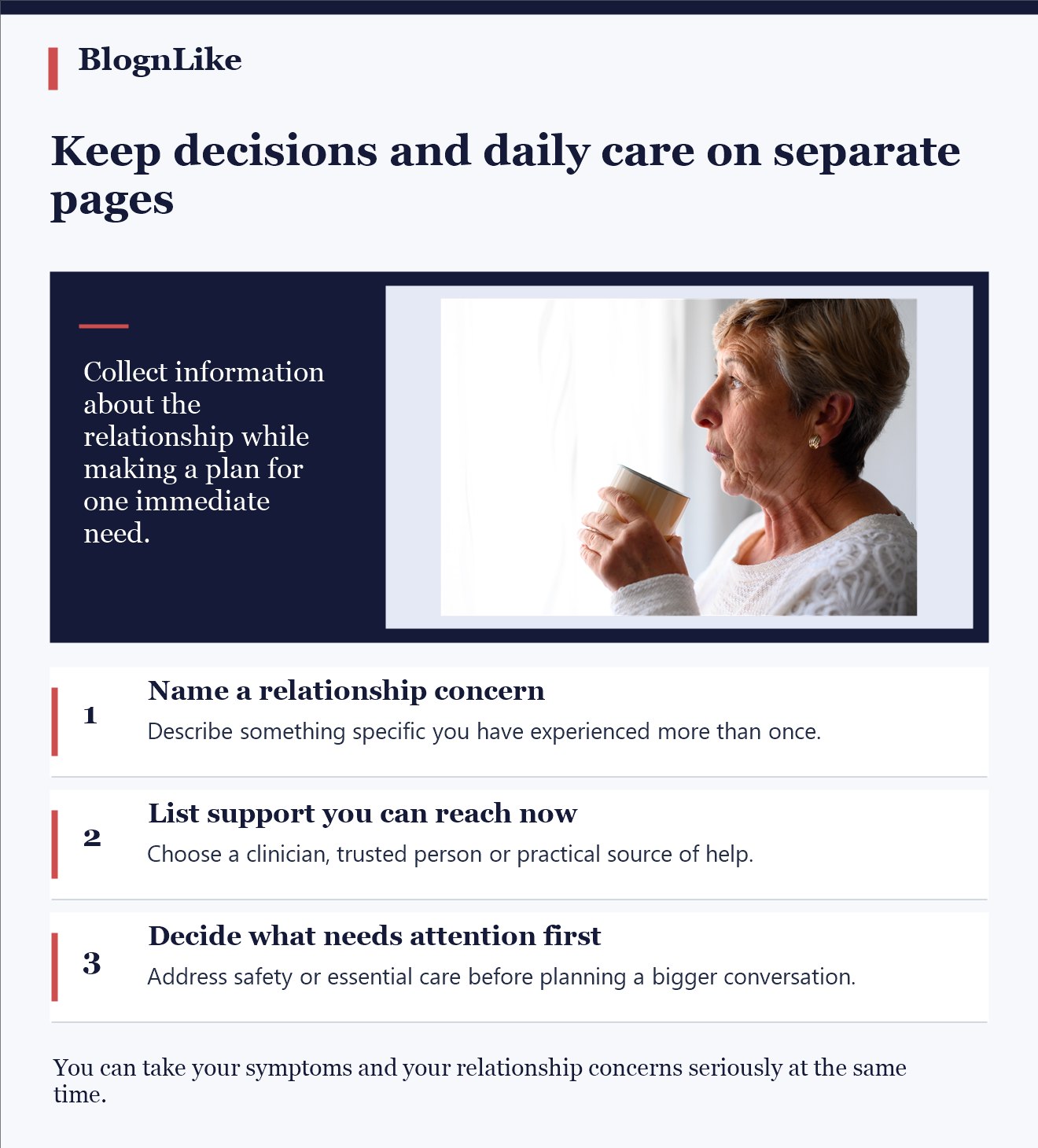
Read the infographic in text
Keep decisions and daily care on separate pages
Collect information about the relationship while making a plan for one immediate need.
- Name a relationship concern Describe something specific you have experienced more than once.
- List support you can reach now Choose a clinician, trusted person or practical source of help.
- Decide what needs attention first Address safety or essential care before planning a bigger conversation.
You can take your symptoms and your relationship concerns seriously at the same time.
Frequently asked questions
1. Does depression mean I should wait to make every relationship decision?
Depression does not take away your ability to choose. Consider the urgency of the decision, any repeated behaviour that concerns you, and the support you can access.
2. What should I do if my daily needs are becoming hard to manage?
Choose one immediate need and ask a trusted person or healthcare professional for appropriate help. Practical support may include company or help arranging an appointment.
3. Do I have to tell my partner everything about my mental health?
Choose what you are comfortable sharing. Consider whether speaking privately with a clinician or another trusted person would be more helpful.
4. What if safety is part of the relationship decision?
Take threats, intimidation and restrictions on your choices seriously. Seek private support from a qualified professional or local advocate.
5. Can I ask for help even if I have already made a decision?
Yes. You can seek support with depression, separation, housing or other practical needs whether you have decided what to do or are still considering your options.