

Wanting lasting love can bring hope and pressure, especially when people around you seem settled. There is no set of steps that can guarantee a partner or make a relationship last. These five practices can help you approach dating with attention to your own needs and the other person’s choices.
1. Notice your feelings and the person’s actions
Your intuition can help you recognise comfort, curiosity or unease. You can take those feelings seriously without treating them as proof of another person’s intentions. If you want to leave a date or slow down, you do not need to establish that the other person has done something wrong.
Alongside that inner response, notice practical behaviour. Do they respect a no, keep an agreement and make room for your preferences? If words and actions differ, you can ask about the difference and decide what it means for you. A strong first impression does not settle every question.

2. Make room for opportunities without forcing an encounter
Meeting people can begin through a shared activity, an introduction or an app you choose to use. Pick an option that fits your interests, access needs and available energy. You do not have to turn every commute or errand into a search for a partner.
If you start a conversation, pay attention to whether the person wants to continue. A brief friendly response may simply be polite. You can offer an invitation that is easy to decline and then leave the decision with them, rather than treating persistence as a way to create interest.
3. Practise self-kindness without making it a dating qualification
You deserve consideration while you are still learning to feel more confident. You do not have to love every part of yourself before you can date. If a gratitude note or private journal feels useful, try it because it helps you reflect, rather than to become worthy of affection.
Choose one practical way to support yourself before a meeting: arrange comfortable transport, wear something that feels like you or set a limit on how long you want to stay. Confidence can vary from day to day. A date is an opportunity to learn about each other, not a verdict on your value.
4. Look for mutual effort and room to grow
Consider whether both people can raise concerns, share decisions and follow through on changes. An apology or a promise matters most when you can also see what happens afterwards. You can appreciate a person’s good qualities while noticing an important difference in expectations.
Growth does not mean accepting hurtful behaviour while waiting for someone’s potential. Neither person is responsible for supervising the other’s development. Talk about a specific need and a realistic request; then consider whether the response works for you, rather than predicting the whole relationship from a single moment.
5. Choose support that respects your decisions
A trusted friend or a thoughtful couple may offer ideas about handling ordinary relationship questions. Their experience can be one perspective, not a guarantee that the same choices will suit you. Ask about what they learned, and keep room to consider your own circumstances.
If you want professional support, choose an appropriately qualified person for the concern you want help with. Advice should leave room for your questions, limits and decisions. You do not need a guru, a fixed deadline or a promise that the universe will deliver a perfect partner.
If a particular relationship is developing, explore whether its everyday patterns work for you. If you need time away from dating, the guide to taking a dating break offers another option. You can want closeness while choosing a pace that fits your life.
A simple test of how dating fits the rest of your life
Plan a second date around something you both said you enjoyed. Ask what time would suit the other person’s commitments and be clear about when you need to leave. When something changes, see whether both of you can adapt the plan without pressure.
Afterward, consider whether you had room to ask questions, keep your ordinary commitments and make one new plan at a pace you liked.
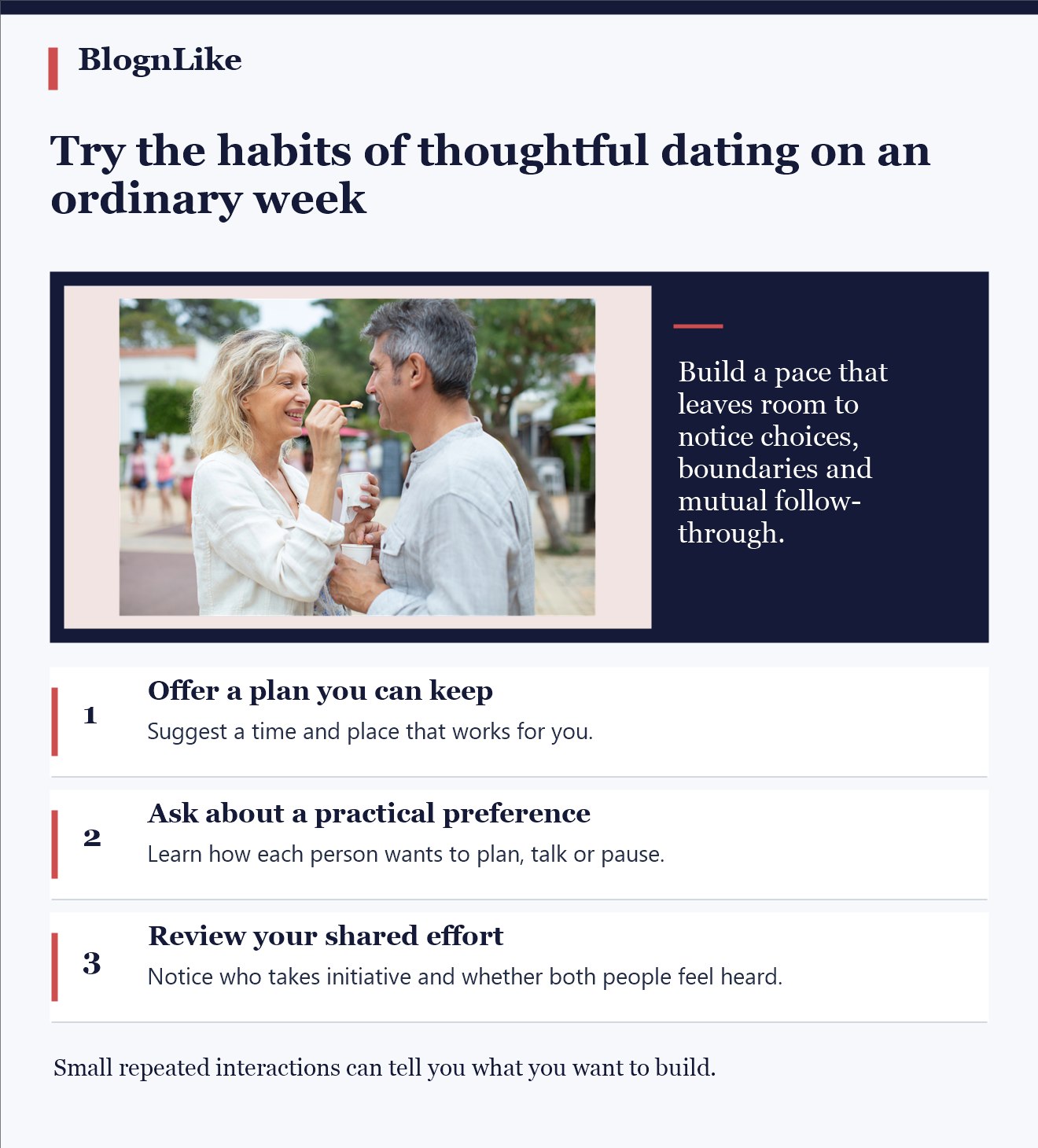
Read the infographic in text
Try the habits of thoughtful dating on an ordinary week
Build a pace that leaves room to notice choices, boundaries and mutual follow-through.
- Offer a plan you can keep Suggest a time and place that works for you.
- Ask about a practical preference Learn how each person wants to plan, talk or pause.
- Review your shared effort Notice who takes initiative and whether both people feel heard.
Small repeated interactions can tell you what you want to build.