

Wanting not to fall in love often means wanting some space: you may be recovering from hurt, attracted to someone unavailable or simply not interested in dating right now. You can take that wish seriously without expecting yourself to switch off every feeling.
The practical question is what you want to do with the attraction. You can choose your pace, the contact you have and the commitments you make. Those choices cannot guarantee that you will avoid disappointment, but they can help you act in line with your needs.
On this page
Distinguish feelings from decisions
Being drawn to someone does not require asking them out, starting a relationship or agreeing to more intimacy. You can enjoy a feeling and still decide that pursuing it does not fit your circumstances. You can also feel disappointed about a sensible decision.
Try naming what you know without deciding immediately whether it is “real love.” You might be curious about someone, enjoy their company, want reassurance or miss having a partner. More than one feeling can be present. Loneliness does not make you unworthy of dating, and attraction does not establish compatibility.
Instead of demanding, “I must stop thinking about this person,” choose an action you can carry out: put the phone down for dinner, decline a date or return to a task that needs attention. A thought returning is not proof that your boundary has failed.
What Love Can Feel Like: Feelings, Care and Mutual Choice explores why feelings and a mutually chosen relationship are different questions. You do not need to settle a label before deciding what you are comfortable with now.

Choose the pace and limits you want
Be specific about why you want to slow down or step back. Perhaps you want time after a breakup, have an existing commitment, need more information or do not want a romantic relationship with this person. You do not need a dramatic reason or a diagnosis to decline dating.
Turn that preference into a clear limit. “I am not dating at the moment,” “I would like to keep this as a friendship” and “I am interested, but I want to meet less often” communicate different choices. Avoid promising a future relationship just to soften an answer you already know.
Listen to the other person’s answer too. They may not want friendship or a slower arrangement, and neither of you has to agree to something unsuitable. A boundary describes what you will participate in; it cannot require someone else to wait, reciprocate or change their feelings.
Notice how your limits are received. Repeated pressure, threats, monitoring or punishment for saying no deserve attention beyond managing a crush. If you feel afraid or controlled, seek support from someone you trust or a local relationship-abuse service. You do not have to negotiate closeness to keep someone calm.
Make contact boundaries practical
Choose a level of contact that fits the situation. You might mute updates, stop late-night messaging, decline one-to-one dates or take a break from optional contact. These are options to consider, not rules that everyone must follow to be disciplined enough.
If you work, study, parent or share a social circle together, complete avoidance may be unrealistic. Keep necessary communication focused on the shared responsibility. You could agree to use one channel for arrangements and leave personal conversations for another time, or decline them altogether.
When appropriate and safe, explain the change briefly: “I need some space, so I will not be meeting up for a while.” You do not owe a detailed account of private feelings. If the person has asked for no contact, respect that request rather than looking for reasons to keep checking in.
Taking space should not become a tactic to make someone chase you. If your aim is to find out whether they are interested, a clear invitation and their answer provide more useful information than a test. If your aim is distance, choose a boundary you can sustain.
Keep room for the rest of your life
Leave room for rest, friends, responsibilities and activities you value. You do not have to fill every hour, transform your appearance or become more productive to earn a relationship. A quiet evening or a manageable plan with a friend can be enough for today.
Try speaking to yourself without turning rejection or uncertainty into a verdict on your worth. “This is disappointing, and I can decide my next step” gives you more room than “Nobody will ever choose me.” Building Self-Esteem: A Fairer View of Yourself offers further ways to question harsh conclusions.
A trusted person can listen or help you think through a decision, but you do not need them to declare the other person good or bad. Ask for the kind of help you want: company, a practical plan or a conversation without pressure to date.
The NHS guidance on relationships and wellbeing recommends boundaries, time for yourself and support outside the relationship. Keeping those connections can matter whether you are single, dating or taking a break.
Review your choice without a deadline
Past relationships can inform your preferences without proving that every future connection will end the same way. Ask what you want to carry forward: clearer agreements, a slower pace, more privacy or a decision to remain single. You do not have to turn past pain into a lesson before you are allowed to move on.
You can review a boundary when circumstances change, while recognising that the other person’s choices may have changed too. There is no need to promise when you will be ready or assume that accepting yourself will guarantee a partner.
If distress is persistent, disrupts sleep or makes everyday tasks difficult, consider professional support. The National Institute of Mental Health explains when to seek help and how to discuss concerns with a healthcare provider. Support can focus on how you are coping, without deciding whether your attraction deserves a particular label.
You may keep some feelings while choosing not to pursue a relationship. What matters is having room to make your own decisions, respect the other person’s answer and care for your life as it is now.
Read the infographic in text
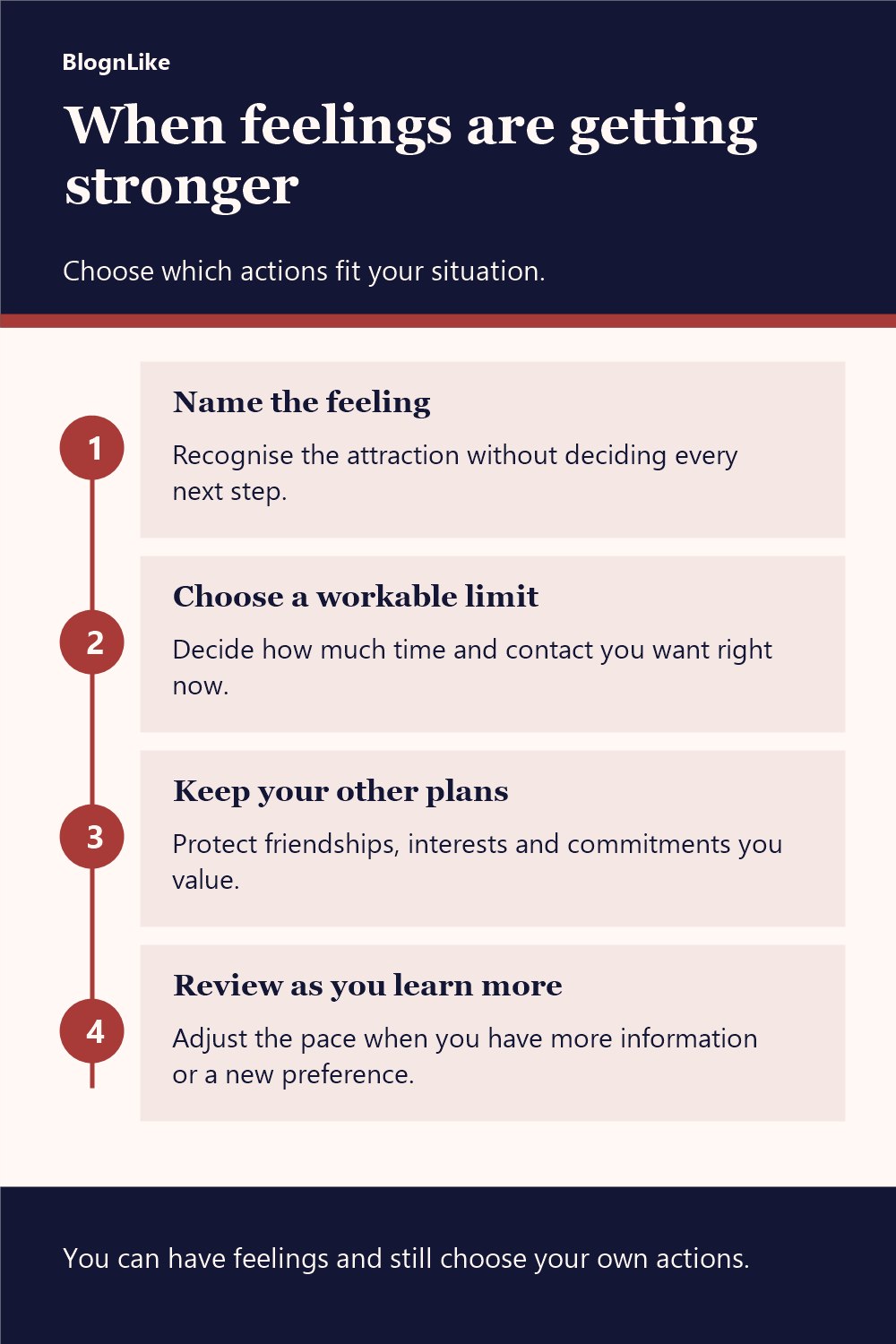
When feelings are getting stronger Choose which actions fit your situation.
- Name the feeling Recognise the attraction without deciding every next step.
- Choose a workable limit Decide how much time and contact you want right now.
- Keep your other plans Protect friendships, interests and commitments you value.
- Review as you learn more Adjust the pace when you have more information or a new preference.
You can have feelings and still choose your own actions.