

If you want commitment and feel unsure where you stand, look at clear agreements and recurring behaviour. These 11 situations can prompt a conversation. None lets you read someone’s mind or proves that a man—or any partner—cannot care about you.
You do not need to build a case against someone before deciding that the relationship does not suit you. Start by naming what commitment means to you, then find out whether the other person freely wants the same arrangement.
1. Plans rarely make room for you
Separate an occasional independent plan from an ongoing mismatch. You do not need to attend every outing together. But if you want regular time as a couple and no plans ever become concrete, ask what time each of you is willing to make.

2. Important conversations keep getting deferred
Nobody owes every detail of their childhood or private history. The concern is whether you can discuss the relationship’s present needs. If each attempt is postponed, suggest a specific time and notice whether the conversation actually happens.
3. You carry nearly all the effort
Look beyond who sends the most messages. Consider invitations, planning, practical care and repairing misunderstandings. Different contributions can still feel mutual. If you are keeping the connection going alone, describe the imbalance and ask what the other person can realistically offer.
4. You want different futures
Someone may care about you while wanting a different kind of relationship. Ask about the issue that matters: exclusivity, living arrangements, children or another commitment. “I do not know” can be an honest answer, but you can decide that uncertainty does not fit your needs.
5. Contact does not match your agreement
A few quiet days do not have one universal meaning. Discuss contact preferences and any practical limits instead of secretly withdrawing to test their reaction. Repeatedly ignoring a clear agreement is more useful to consider than guessing what a delay means.
6. Agreed responsibilities are repeatedly missed
Forgetting an anniversary or a coffee order does not prove a lack of love. Focus on significant agreements and what happens after a mistake. Do they acknowledge the effect, help solve the problem and use reminders or another arrangement when needed?
7. You cannot discuss where you fit
Privacy and independence can be healthy. You are still allowed to ask what being a couple means to each of you. If your partner refuses any conversation about your place in their life, consider whether the relationship being offered meets what you want.
8. Warm words do not lead to reliable choices
A loving message matters, but it does not settle a recurring concern about plans or follow-through. Name the specific pattern and request a concrete change. Notice what happens over time without treating each affectionate moment as proof that the question is resolved.
9. Introductions have become a source of uncertainty
Meeting family or friends can depend on distance, culture, safety, estrangement and personal timing. There is no universal deadline. Ask about the context and what introductions would mean to you. Avoid assuming secrecy solely because a family meeting has not happened.
10. Time together is limited to a kind of intimacy you do not want
If you want conversation, dates or shared activities as well as sex, say so. Someone else may want a casual connection; neither person has to agree to that arrangement. You can decline sexual contact and leave a relationship that does not offer the connection you want.
11. Your exclusivity agreements do not match their behaviour
Friendships with other people are not proof of disloyalty. If exclusivity matters, discuss what each of you is agreeing to, including dating apps and romantic contact. Deception or repeated breaches of that agreement deserve a direct response; surveillance is not a substitute for trust.
Ask clearly and choose a next step
Choose a calm time if you feel safe doing so. You could say: “I want an exclusive relationship where we make regular plans. Is that what you want, and what would that look like in practice?” Listen for a clear answer instead of negotiating away the need that prompted your question.
If you both want a change, agree on something specific and a time to check back. If they do not want commitment, take that answer seriously. If they remain uncertain, decide how much uncertainty you are willing to live with; you are not obliged to wait indefinitely.
For a structured conversation, use the weekly relationship check-in. If you are considering leaving a one-sided connection, the guide to mutual dating effort offers wording for stepping back.
If asking for clarity brings threats, intimidation or punishment, prioritise support over another relationship test. Love is respect’s relationship spectrum can help distinguish unhealthy or abusive patterns from ordinary differences.
When a future promise leaves the current relationship unclear
If someone talks about moving in someday but stays vague about making a plan for the next week, talk about the part you can both answer now. “Are we trying to set aside regular time together? What would that look like this month?”
Review whether both people have time to follow through. You can keep your own plans moving while you decide what kind of commitment you actually have room for.
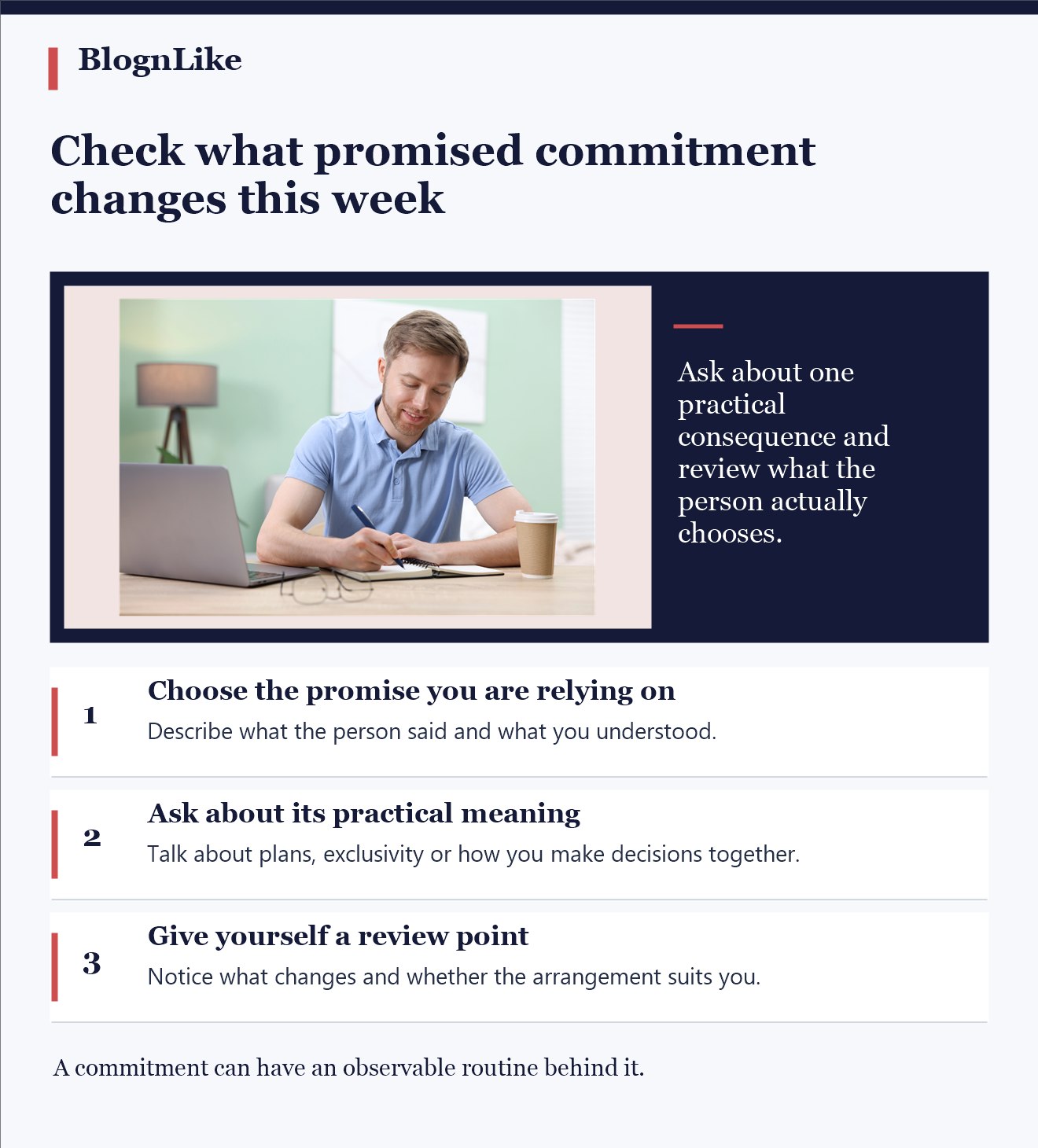
Read the infographic in text
Check what promised commitment changes this week
Ask about one practical consequence and review what the person actually chooses.
- Choose the promise you are relying on Describe what the person said and what you understood.
- Ask about its practical meaning Talk about plans, exclusivity or how you make decisions together.
- Give yourself a review point Notice what changes and whether the arrangement suits you.
A commitment can have an observable routine behind it.