

If you describe yourself as independent, ambitious or an “alpha woman,” you may want a boyfriend who respects that independence. The label does not have to determine your role or his. These 18 qualities offer practical things to notice and discuss while getting to know a partner.
They are not a perfection test or a way to infer someone’s character from a single date. Many of these qualities matter in relationships of any gender. Focus on recurring behaviour, what each person wants and how you respond when something needs attention.
Humour, respect and trust
1. Humour feels comfortable for both of you
Notice whether jokes leave room for both people to enjoy themselves. A partner can be playful without targeting your insecurities. If you say a joke hurts, a useful response is to listen and adjust rather than insist that independence means you should tolerate it.
2. Your opinions are taken seriously
You do not need identical views to enjoy conversation. Look for a person who asks questions, explains a disagreement and leaves room for your answer. Constantly challenging you to prove your worth is different from a discussion you both find engaging.
3. Jealous feelings do not become controlling rules
Someone can acknowledge insecurity while taking responsibility for how they act. Consider whether you can keep friendships, make ordinary choices and discuss expectations without interrogation. Confidence alone does not establish trust; how a person treats your independence matters more.
4. There is room for separate interests
A partner can enjoy time together while maintaining friends, activities and rest of their own. Talk about how your schedules affect each other. Neither person should need permission for every ordinary plan or have to become the other’s entire social life.
5. Private information is treated with care
Ask what each of you considers private, and notice whether those preferences are respected. Protecting privacy does not mean preventing someone from seeking confidential help. The guide to setting boundaries offers another starting point for that conversation.

Support and life plans
6. Support does not require accepting hurtful behaviour
You may want comfort after a hard day, and a partner may sometimes need space. Both needs can be discussed. One person is not responsible for managing every mood, and being upset does not give either person permission to insult, intimidate or punish the other.
7. An apology includes responsibility
Look for an acknowledgement of what happened, room for your response and a realistic change in behaviour. A quick apology can matter, but it should not end the discussion automatically. Neither person owes immediate forgiveness or physical affection in return.
8. Life plans can be discussed without one person disappearing into the other’s
A supportive partner can care about your ambitions while having priorities of their own. Talk about practical choices involving time, work, family and location. A shared plan needs both voices, rather than a standing assumption that one career or preference takes precedence.
9. Achievements are welcomed without comparison
It can feel good to share news with someone who is interested and pleased for you. Notice whether achievements become an occasion for rivalry, belittling or demands for reassurance. You can celebrate each other without having matching goals or identical measures of success.
10. Advice is offered with room for a choice
Sometimes you want suggestions; sometimes you want someone to listen. A considerate response can begin with “Would you like ideas or a listening ear?” Support does not require turning you into a project or providing a running assessment of what you should improve.
Everyday choices
11. Ordinary time together can be enjoyable
You do not need someone who entertains you constantly. Consider whether you enjoy conversation, a quiet activity or a routine evening together. Different energy levels and tastes can coexist when both people can say what they would like.
12. Honesty leaves room for respect
Being direct does not require attacking someone’s character. A partner can name a concern, explain its effect and make a request. Consider whether both of you can respond honestly without being mocked for an answer or told that cruelty is simply “telling the truth.”
13. Help does not turn into taking over
Ask what support means to you: encouragement, sharing a task, practical information or time to make a decision. A partner can offer help while respecting your answer. Being protective should not become deciding where you go, whom you see or what you are allowed to choose.
14. Social plans respect adult choices
You can discuss the kind of evening you want, how you will travel and what would make the plan comfortable. Notice whether care comes with an expectation of obedience. Both people should be able to express preferences rather than one person appointing themselves supervisor.
15. There is room to learn and reconsider
A useful conversation allows someone to say “I may be mistaken” and take in new information. Beliefs and values may differ. Respectful curiosity does not require agreement on everything, but it does leave room to understand what matters to the other person.
Conversation and shared hopes
16. Difficult topics can be paused and revisited
If a discussion becomes overwhelming, a pause can help when you agree how to return to it. Notice whether a pause becomes a way to avoid every concern indefinitely. You can ask for a calmer conversation without giving up the subject entirely.
17. Both people have room for their own hopes
A partner’s ambitions may involve work, creativity, caregiving, community or something quieter. They do not have to mirror yours. Consider whether you can discuss those hopes and the responsibilities involved without treating one person’s life as an accessory to the other’s.
18. Listening goes both ways
Look for space to finish a thought, ask a question and check what each person meant. You also need room to hear your partner’s experience. Mutual respect does not mean agreeing automatically; it means that both voices count when you make decisions.
Choose what matters to you
Choose two or three qualities that address a real need in your life. You might ask how someone handles time apart, offers support or shares responsibility. A conversation gives you more to work with than assuming a confident appearance guarantees a considerate partner.
Keep the question mutual: what do you want to offer, and what do you need in return? For help discussing a specific concern, try the weekly relationship check-in. You can value your independence while choosing closeness that feels welcome.
Read the infographic in text
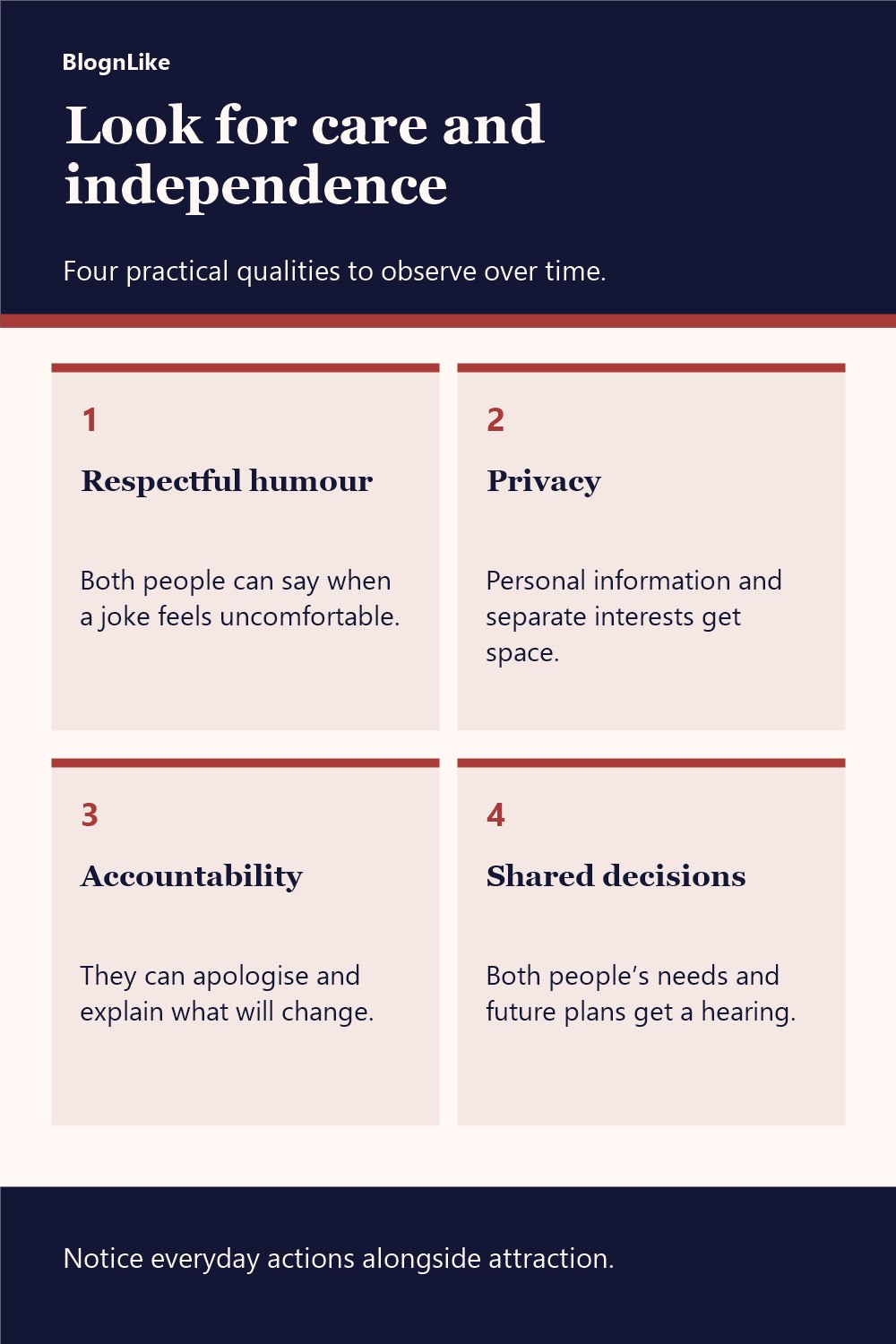
Look for care and independence Four practical qualities to observe over time.
- Respectful humour Both people can say when a joke feels uncomfortable.
- Privacy Personal information and separate interests get space.
- Accountability They can apologise and explain what will change.
- Shared decisions Both people’s needs and future plans get a hearing.
Notice everyday actions alongside attraction.