

A relationship can have enjoyable moments and still leave important questions unanswered. These signs are areas to consider, rather than proof that you have found a perfect partner. Look at recurring behaviour, your own wishes and whether there is room for both people’s choices.
1. You can enjoy time together without liking everything alike
Notice which activities you both freely enjoy and whether there is room to take turns choosing. A shared interest can be pleasant, but you do not need to discover one magical activity that settles whether the relationship is right. Ask what time together feels like in ordinary life.
2. Time apart is respected
You can care about someone while needing rest, friendships or an interest of your own. Discuss plans that affect each other without treating independent time as rejection. A workable arrangement leaves both people room to choose rather than requiring one person to be constantly available.
3. Concerns can be discussed without a contest
Consider whether you can raise a specific issue and work towards a practical response. You do not have to argue regularly to have a real relationship. If disagreement happens, insults, threats and intimidation are not necessary stages of solving a problem.

4. Friendships can continue
A relationship can include shared friends and separate connections. Look at whether you can maintain those connections without surveillance or demands to prove loyalty. You can discuss a particular concern about behaviour without treating every outside friendship as a threat.
5. You can remain yourself
Ask whether there is room for your preferences, values and choices. Sharing a life may involve compromise, but it should not require giving up your voice. You are allowed to change your mind about a plan and discuss how that affects the other person.
6. Other people’s views are considered in context
A trusted person may notice a concrete concern worth hearing. Their approval or disapproval does not decide the relationship for you. Ask what behaviour they have observed, and consider whether bias, personal preferences or pressure may also be affecting their view.
7. A different opinion does not put you at risk
You can disagree about a decision without having to earn permission to speak. Notice if you feel afraid of punishment for a refusal. That deserves attention beyond a compatibility checklist; you do not need to find better arguments before you are entitled to safety and respect.
8. Support makes room for both people’s goals
A partner can encourage an ambition without deciding what your life should become. Ask whether practical support and recurring responsibilities are shared fairly. One person should not have to postpone every goal so the other can pursue theirs.
9. Your relationship intentions can be discussed clearly
Talk about the kind of relationship you want now and the future questions that matter to you. Shared affection does not automatically mean shared plans for exclusivity, children, marriage or living arrangements. A difference may be important even when neither person is doing anything wrong.
10. Attraction can sit alongside ordinary compatibility questions
You may enjoy physical attraction, conversation, shared values or several kinds of connection. Notice what you actually want with this person. A strong feeling does not answer how you handle a disagreement or whether your expectations fit.
11. Privacy and access to support are respected
You can agree to protect sensitive information about each other. That should leave room to seek confidential support about your own experience. Keeping a partner’s confidence does not require concealing threats, accepting isolation or surrendering passwords to prove trust.
12. Shared tasks do not depend on one person managing everything
Consider how you plan, make decisions and follow through on responsibilities. Useful teamwork can include adapting to different capacities and schedules. It also means discussing what happens when a task is missed, rather than assuming one partner will carry all the reminders.
13. Ordinary life has room for care and frustration
Some chores may be more pleasant together; others will still be tedious. A good day does not prove compatibility, and a dull evening does not disprove it. Look at the broader pattern of consideration, cooperation and enjoyment without expecting constant entertainment.
14. Intimacy preferences can be discussed without pressure
Relationships differ in the place of sex, touch and other forms of intimacy. Ask what each person freely wants, including when sexual activity is not wanted. Compatibility does not create an obligation to agree to something uncomfortable or to remain unchanged over time.
15. Money conversations can be honest and practical
Discuss money when it affects shared plans, responsibilities or decisions you are considering together. Different resources and priorities do not determine anyone’s worth. Aim for clear agreements rather than assuming that a particular income, a gift or financial dependence proves the relationship is right.
Use the signs to choose a conversation
Pick one area that matters now and ask a concrete question. You can use the weekly relationship check-in to discuss one concern, one request and a time to revisit an agreement.
No list can guarantee a lasting relationship or require you to stay. If you are unsure about a pattern, Love is respect’s relationship spectrum distinguishes healthy, unhealthy and abusive behaviour. Your preferences and safety matter alongside the affection you feel.
When both people have a different idea about an upcoming holiday
Suppose one person wants to visit family and the other needs time to rest. Discuss the length and timing of the visit. Make room for each person’s preferences and see whether both people accept the final decision freely.
Notice whether you can disagree and still depend on the other person to treat you with care. One exchange gives you a useful example, and repeated exchanges help you see the pattern.
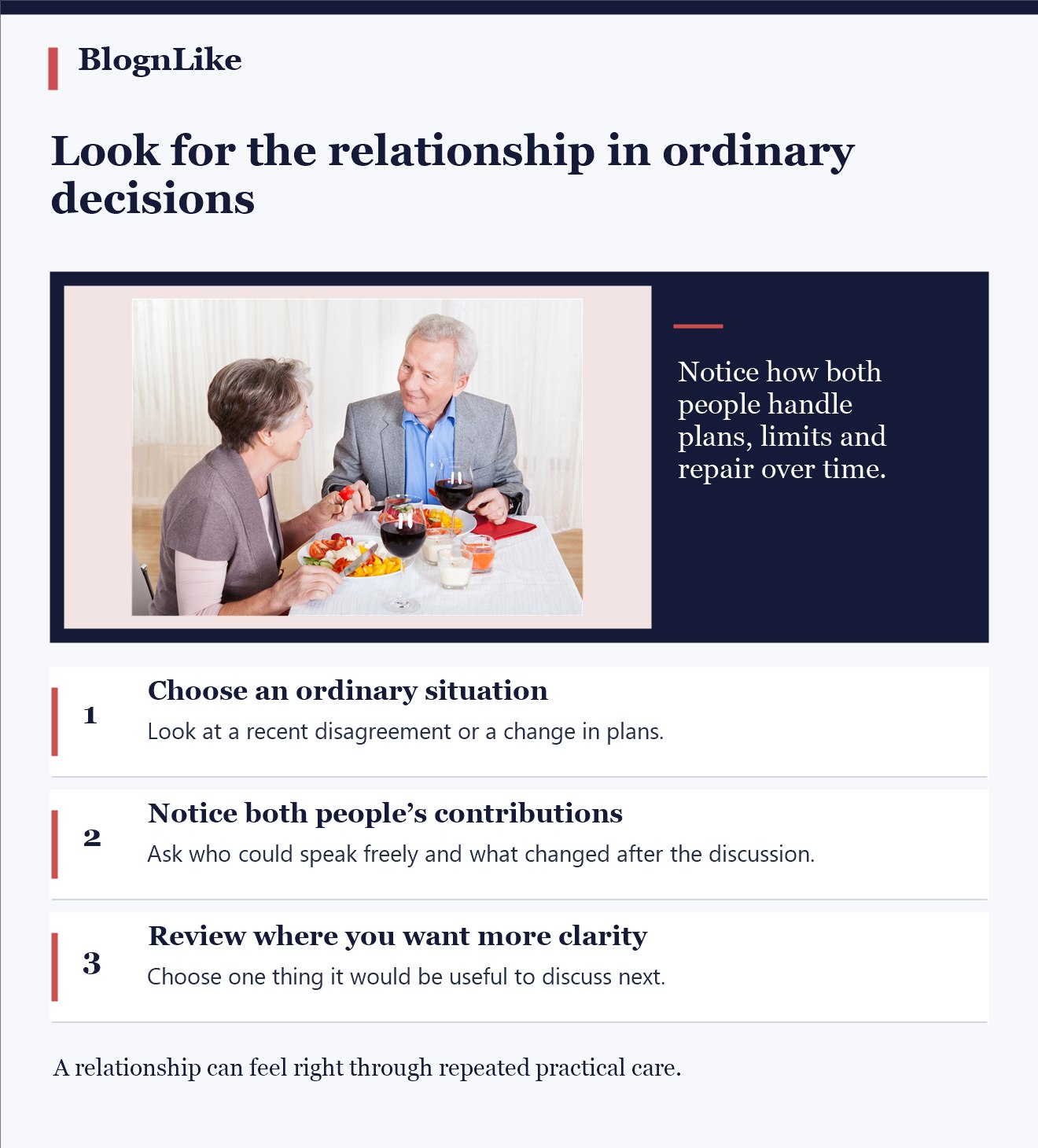
Read the infographic in text
Look for the relationship in ordinary decisions
Notice how both people handle plans, limits and repair over time.
- Choose an ordinary situation Look at a recent disagreement or a change in plans.
- Notice both people’s contributions Ask who could speak freely and what changed after the discussion.
- Review where you want more clarity Choose one thing it would be useful to discuss next.
A relationship can feel right through repeated practical care.