

You can want a relationship and still choose to take a break from dating. A break can give you time for other parts of life, but it does not guarantee that love will arrive when you stop looking. You are allowed to decide how much attention dating deserves right now.
Wanting companionship is not a weakness. If the search has become tiring, consider what would make it more manageable: fewer conversations, a pause from apps, different ways of meeting people or time away from dating altogether.
Let a first meeting stay a first meeting
A first date gives you a chance to learn a little about someone. You do not have to decide whether they are your future partner before you have spent time together. Start with smaller questions: did you feel comfortable, did the conversation leave room for you, and would you like another meeting?
You can be interested without making a promise. If you are unsure, take time to think rather than treating uncertainty as a failure. Equally, you do not owe a second date because the other person was polite or seems enthusiastic.

Wanting connection does not make you weak
It can be painful to want closeness and not have the relationship you hoped for. That feeling does not make you less worthy of love or mean you should hide your wish for companionship. You can acknowledge disappointment and still choose what you want to share on a date.
Look for ways to treat yourself fairly while you make those choices. The existing guide to building self-esteem offers another perspective. You do not need perfect confidence or a completely settled life before you are allowed to date.
Choose what a dating break means for you
A break can be specific and flexible. You might pause new matches, turn off notifications or keep only the conversations you genuinely want to continue. You can also step away completely. Choose the boundary that addresses what is tiring you, rather than following a rule about how long single people should wait.
If you are already seeing someone, explain what the change means instead of leaving them to guess. For example: “I am taking a break from dating and will not be arranging another date.” If you want to keep seeing them while leaving an app, say that clearly too.
Keep interest mutual and unforced
You can make an invitation and let another person decide whether to accept it. Repeated persuasion, strategic silence or pretending not to care cannot create a freely chosen connection. A clear answer gives you more to work with than a plan to make someone chase you.
Notice whether both people make an effort. If you are always proposing plans and receiving vague replies, you can ask once what they want, or decide that the arrangement does not work for you. You do not need to prove why someone is unavailable before choosing to move on.
Use clear standards when you meet someone
Consider what matters in practice: respect for a refusal, compatible relationship intentions, room for your own interests and willingness to discuss a disagreement. These can guide your decisions alongside attraction. You do not need to make a checklist of surface details or excuse behaviour that leaves you uncomfortable.
After a date, separate what happened from what you hope it means. “We enjoyed talking” is useful information. “This must be my only chance” adds a conclusion you do not have to accept. You can appreciate a promising meeting while learning more at a comfortable pace.
Make room for beliefs without blaming yourself
If prayer, manifestation or spiritual reflection helps you clarify what you want, you can include it in your life. It cannot establish another person’s feelings or make their consent unnecessary. A relationship still involves two people choosing whether to take part.
Disappointment is not proof that you sent out the wrong thoughts or failed to stay positive. You can feel sad, uncertain or frustrated and still act with care. Let a spiritual practice support your choices rather than become another standard you must meet to deserve love.
Reduce the load when dating becomes tiring
Choose one change that would make the next week easier. Perhaps you would prefer fewer app conversations, shorter first meetings or more evenings without dating plans. Keep time for friendships, rest and interests that matter to you even if they never lead to a romantic introduction.
You can also tell friends what kind of support you want. “I would like company, but I do not want to discuss my dating life tonight” is a reasonable request. Enjoying your life does not have to become a technique for attracting a partner.
Return when the pace works for you
If you decide to date again, begin with a manageable step rather than trying to make up for lost time. You might accept one introduction, update a profile or suggest a meeting with someone you would like to know better. You can review how it feels and adjust.
There is no deadline for returning and no promise that patience will produce a particular partner. Choose a pace that leaves room for your preferences, your limits and other people’s choices. For help keeping a conversation open, try asking with curiosity while respecting limits.
A short break that still leaves room for company
If coordinating several dates has begun to crowd out sleep and friends, try a pause on arranging new dates for two weekends. Keep one plan with a friend and choose when to look again at how you feel.
Say what you can offer clearly if someone is expecting a reply. When you review the pause, ask whether you want to return at a different pace or use the time for other parts of your life.
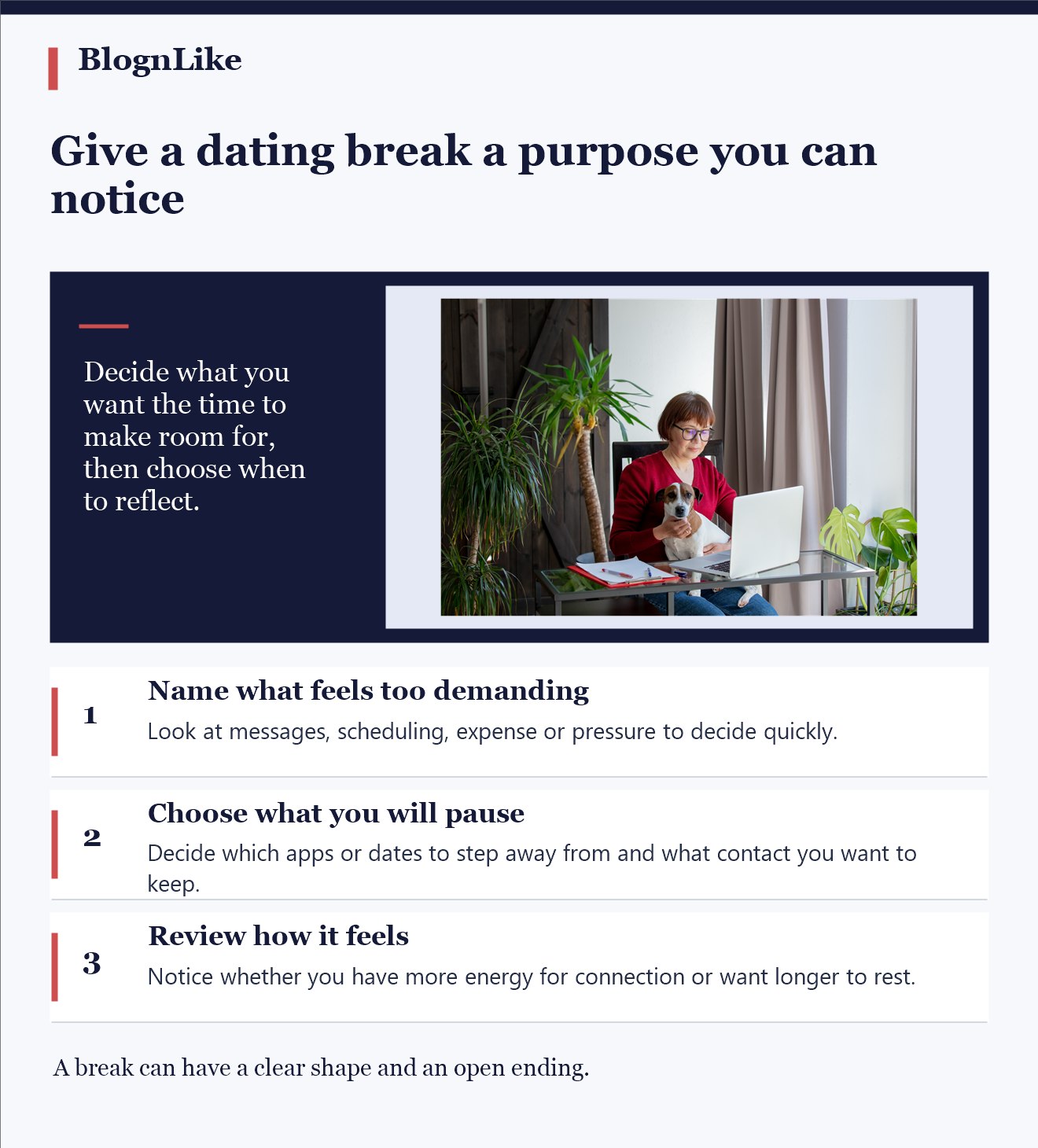
Read the infographic in text
Give a dating break a purpose you can notice
Decide what you want the time to make room for, then choose when to reflect.
- Name what feels too demanding Look at messages, scheduling, expense or pressure to decide quickly.
- Choose what you will pause Decide which apps or dates to step away from and what contact you want to keep.
- Review how it feels Notice whether you have more energy for connection or want longer to rest.
A break can have a clear shape and an open ending.