

Many people use the law of attraction to focus on their hopes for love. If you have a specific person in mind, you can reflect on what you want while leaving them free to choose something different. A manifestation practice is not an agreement to date and does not establish how another person feels.
1. Name the relationship you hope to experience
Instead of concentrating only on a particular person’s response, describe the qualities you want to share: consideration, honesty, companionship or a freely chosen commitment. A journal, prayer or another personal practice can give you space to reflect on those hopes if it is meaningful to you.
Keep the intention connected to your own choices. You can decide how you introduce yourself, what invitation you offer and which agreements you are willing to make. The other person has the same freedom to want a different relationship or no relationship.

2. Let confidence include uncertainty
You can be interested in someone while feeling nervous. You do not have to become perfectly confident or stop caring about the answer before you can make a respectful invitation. A refusal can hurt without being a verdict on your worth.
If you use affirmations, choose wording that supports your agency: “I can express interest and respect the response” leaves room for both people. An affirmation does not need to promise that another person will act in a particular way.
3. Notice what you actually know
Separate something you observed from the meaning you hope it has. A friendly message is a friendly message until you have clearer information about romantic interest. Look for a direct answer and mutual willingness rather than treating repeated coincidences or a strong feeling as an agreement.
You might ask whether someone would like a date. Our guide to clarifying flirting and friendliness offers wording that leaves room for an honest answer.
4. Keep positive attention broad enough to include concerns
Appreciating a person’s qualities can be pleasant. It does not require ignoring a boundary violation, an important difference or the way a relationship affects you. You can notice something good and still decide that a particular arrangement is not right for you.
If a reflection practice leaves you explaining away every concern or blaming yourself for another person’s choices, consider changing the practice. A more useful question may be what you need to know, ask for or protect now.
5. Make room for the rest of your life
Choose activities, friendships and rest because they matter to you, rather than as a way to attract someone faster. You do not have to maintain a cheerful mood at all times to deserve affection. Sadness or disappointment does not mean you have ruined your chances.
Connection can take more than one form. Spending time with a friend or enjoying an interest can be worthwhile while you still want romance, and it does not need to become a technique for securing a particular person.
6. Treat an existing agreement or a refusal as real information
If a person says no, asks for space or ends contact, respect that answer. Do not use a manifestation practice as a reason to keep messaging, involve their friends or reinterpret a boundary as a test. A relationship needs room for each person to choose it.
If you already have a relationship, discuss the agreement you actually share. Imagining a reunion or hoping for commitment does not change what the other person has agreed to. You can decide whether the available connection fits your needs.
7. Choose a next step you can take yourself
You might make one invitation, clarify a relationship intention, put a limit on contact or choose more time for yourself. An intention can help you identify that step. It does not need to guarantee a partner for the action to be useful.
If the answer is not what you hoped, give yourself room to feel disappointed and seek support. The guide to connection while single offers options that do not depend on a new relationship, and taking a dating break is another choice.
Translate an intention into a choice
Choose an action that would make sense even if the other person’s answer remains uncertain.
| Your intention | A choice you can make |
|---|---|
| Feel more open to dating | Choose one setting where you would enjoy meeting people. |
| Learn whether interest is mutual | Make one invitation that leaves room for a no. |
| Find steadier connection | Discuss contact and relationship intentions, then notice follow-through. |
You can keep a spiritual or personal practice that helps you reflect while taking another person’s words, boundaries and decisions seriously. Let hope make room for mutual choice, including an outcome you did not expect.
Use intention after someone says they want friendship
Suppose someone you like has told you they want to remain friends. If journaling or prayer is meaningful to you, reflect on what the hope tells you about companionship rather than looking for a reason to ask again.
You might decide to reduce contact temporarily, join a class you’ve been considering or make plans with a friend. Revisit what you want while giving the other person room to keep the choice they made.
Read the infographic in text
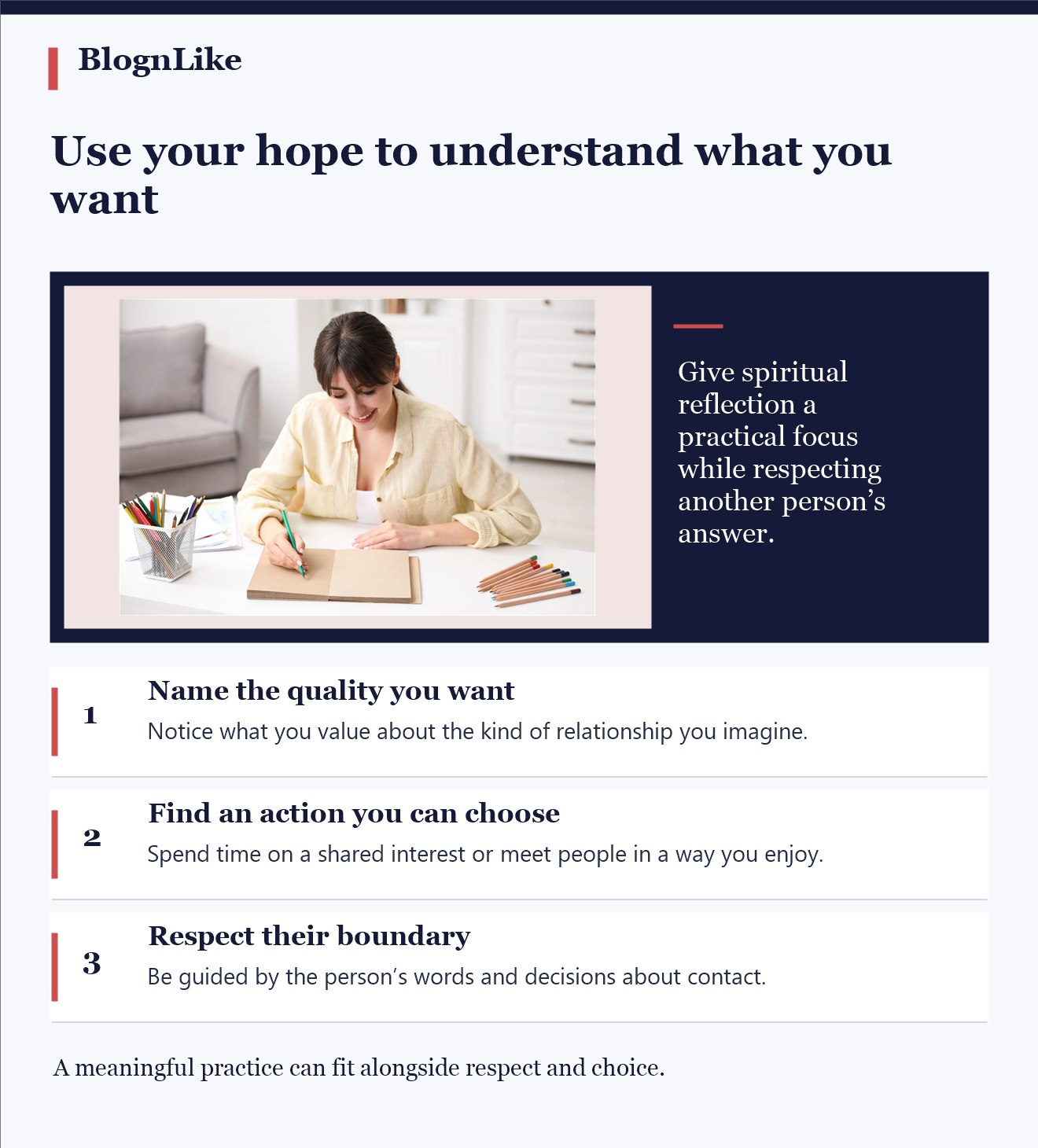
Use your hope to understand what you want
Give spiritual reflection a practical focus while respecting another person’s answer.
- Name the quality you want Notice what you value about the kind of relationship you imagine.
- Find an action you can choose Spend time on a shared interest or meet people in a way you enjoy.
- Respect their boundary Be guided by the person’s words and decisions about contact.
A meaningful practice can fit alongside respect and choice.